Saturday, August 16, 2008

All That Glitters...


This country and the capital Ulaanbaatar were jumping for joy Thursday night with Mongolia’s first EVER Olympic gold medal. Tuvshinbayar N., now a national hero, took the men’s 100kg judo title and the partying began with impromptu revelry and fireworks. Thousands whooped it up on UB’s Sukhbaatar Square. It would be too strong to say that the people consider it a mark of their “arrival,” but their world standing is progressing. They have a silver medal also, earned by the pistol-packing Gundegmaa O, who came within millimeters of winning gold, herself. And I dare say that the Mongolian boxing team is right there alongside America’s for quality depth.

It’s an interesting contrast between Mongolia and home regarding Olympic success. On the one hand, we have this small nation trying to find its way in the world positively ecstatic with a single gold medal. Then, there’s America’s Michael Phelps who could win eight of them by himself. To me, it’s another lesson in trying to take nothing for granted and appreciate the simplest gifts.

We have been able to see vastly more Olympic coverage than of any previous games. The competitions have been available, virtually wall-to-wall, on five stations: three Mongolian, a Chinese and a Russian sports channel. Though I’m an obvious USA and Mongolia fan, it is a great experience to watch the Beijing games on Chinese television – despite not knowing the language. The excitement the people are feeling being hosts, and brilliantly successful ones by athletic standards, is so clear in all the cheers and smiles…..government behavior and scandal aside.

Meanwhile, it’s nice to now feel strongly about two nation’s success at the games.


Wednesday, July 9, 2008

Political Troubles

While we were at our camp in the countryside last week, we had heard only about a fire at the Revolutionary Party headquarters in the wake of the party’s very successful election results. When we returned to Choibalsan, we learned with great sadness of the rioting that took place in the capital on July 1st. In sum, the MPRP did much better than polls had previously suggested, winning a large majority of parliamentary seats. Many people expected the rival Democratic Party to do equally-well, but expectations were not met. Amid allegations of election fraud, agitators turned a peaceful protest into a riot, torching the MPRP building, a national art museum, police station while looting cultural centers and shops. There were several deaths.
A four-day state of emergency (since annulled) was declared in UB, and a 10pm curfew and alcohol ban were imposed. From what we gather, the riots were confined to UB and did not impact life here in Choibalsan. Discussions are underway between the political parties to redress grievances. We hope people will be able to resolve their differences and decide matters, peacefully.

Here is a related piece by Edward Wong that appeared in the International Herald Tribune:


A Challenge for Mongolia's Democracy
By Edward Wong
Tuesday, July 8, 2008


ULAN BATOR, Mongolia: The charred shells of two Soviet-style buildings rising from the center of this capital stand as a warning of the dangers of mixing vodka with voter frustration. In a barren land where nomads still gallop across pastures to polling booths, that potent mix led last week to the literal gutting of some of the country's most prominent political and cultural institutions. Now, with an election in dispute, Mongolia's fledgling democracy faces its biggest challenge since its birth in 1990.

Following cries of fraud in parliamentary elections - accusations that were disputed by international election observers - hundreds of rioters, many of them drunk attacked the headquarters of the dominant political party and the neighboring national art gallery on July 1. Fires were started. Five people were killed. More than 1,000 pieces of artwork were destroyed, damaged or looted.

"Poverty and corruption are eating away at our democracy," said Tsedevdamba Oyungerel, a Stanford-educated politician who ran for Parliament but lost (though she did receive 10 male horses as gifts while campaigning in the countryside.) To Oyungerel, who like many Mongolians goes by her given name, just as shocking as the violence was the government's reaction - it declared a four-day state of emergency, sent soldiers into the streets and shut down television and radio stations. The outburst of violence was without precedent in democratic Mongolia, and many here - from sheepherders to business executives - are deeply ashamed of what unfolded.
"I thought, 'This is totally wrong,' " said Gansuren, a bartender at a karaoke club.

Much is at stake for the United States as Mongolia struggles to right itself. With a population of three million scattered across a country the size of Alaska, it is, as one Mongolian leader put it last week, the only democracy between the Sea of Japan and Eastern Europe. Mongolia has supplied troops for the wars in Iraq and Afghanistan, and the former secretary of defense, Donald Rumsfeld, was given a horse when he visited in 2005 (he left it behind). "Since the overarching aim of our foreign policy is to promote the expansion of democratic society in the world, Mongolia is a poster child for that," said Mark Minton, the American ambassador here. "It's my strong belief that democracy is here to stay in Mongolia."

The state of emergency ended Sunday, and much seems back to normal now in the capital. A wedding couple poses for photos in the central square. A herder leads three loping camels through the streets. The Grand Khaan Irish Pub is packed. But the country faces two major problems: resolving the contentious election - the official results still have not been announced - and identifying the cause of the recent violence.

Though many Mongolians say the riot was a criminal act, the anger most likely bubbled up from economic frustrations. Inflation has soared to 26 percent, Mongolians complain about corruption, and officials disagree on control mining rights to the country's immense mineral wealth. Prime Minister Sanjaagiin Bayar defended the state of emergency on Saturday night, saying the government, which is ruled by the Mongolian People's Revolutionary Party, or MPRP, was concerned with preventing further disturbances. But Oyungerel and other senior members of the main opposition group, the Democratic Party, accused the government of using the riot as a pretext for quashing dissent. The only television station allowed to broadcast from Wednesday to Saturday was the national network.

On the surface, Mongolia is an unlikely place for an experiment in democracy. The home of Genghis Khan, it is the most sparsely populated country in the world. Half the population still lives in round felt tents called gers, and livestock outnumber humans eight to one. Yet Mongolia's literacy rate is 98 percent, a legacy of nearly seven decades of Communist rule. The country held a constitutional referendum in 1990 and a vote in 1992 that led to its first democratic change of Parliament. Since then, it had held peaceful elections every four years - until June 29.

Preliminary results announced shortly after the voting showed that the MPRP won 45 seats; the Democratic Party 28 seats; and three small parties one seat each. Those numbers would give the governing party the majority it needs in the 76-seat Parliament to form a government. In a news conference on July 1, however, the leader of the Democratic Party and a former prime minister, Tsakhiagiin Elbegdorj, accused the MPRP of vote fraud. That assertion was challenged by the 52 foreign observation teams that went to polling stations on June 29. "In each of those cases, in each of the instances where we observed any part of the process, we were struck by the degree of rigor," said Bill Infante, country representative for the Asia Foundation, a group that promotes democracy, whose observers visited 100 of about 1,700 stations.

Nevertheless, on the afternoon of July 1 several leaders of smaller parties held a rally at the capital's central plaza, Sukhbaatar Square. The protest began peacefully. But in time an angry crowd of young men formed in front of the five-story headquarters of the governing party, next to the square. Soon they were throwing rocks and storming the building. Police officers fired tear gas and rubber-coated bullets. Nothing worked. The rioters started fires at dusk. They broke into a duty-free shop on the first floor and grabbed the liquor. And some were already carrying bottles of cheap Mongolian vodka. "It was a pity to see how they were demolishing quite expensive drinks," said Sumati, a pollster here. "It's $30 or $40 a bottle. It's really not cheap."

Rioters barged into the museum next door, the Mongolian National Modern Art Gallery. They set fire to the building at 11:30 p.m. and made off with some wood and ivory carvings, said Enkhtsetseg, the museum director. Two storage rooms with modernist oil paintings suffered fire damage, as did a wing of traditional art that included tapestries, paintings and carvings. Of the museum's 5,000 pieces, more than a fifth were destroyed, damaged or stolen, Enkhtsetseg said. None are insured.

"I have no idea how to put a value on this," she said as she chain-smoked in her office on Sunday (she had quit six years ago, but took it up again last week). "It's unique; we don't have anything like this. Most of the artists have passed away." Next door, in the home of a national orchestra, horse-head violins had been destroyed. The police arrested more than 700 people, and as of Saturday more than 200 were still in jail, Prime Minister Bayar said at a televised news conference that night. "The police are paying attention not to violate human rights or treat prisoners badly," he said.

But some Mongolians say prisoners have been tortured. Enkhtsetseg said a prisoner released on July 3 came to her office and showed her bruises on his back. He had been among a group of young men trying to save artwork the night of the riot but had been mistakenly arrested, Enkhtsetseg said.

As the country's leaders grapple with how to resolve the election, everyone knows nothing less than the future of Mongolia is at stake. "We made our democracy ourselves, we will defend it ourselves," Oyungerel said. "I love democracy. I want to give this society to my children."

Youth Ecology Camp

The first week of July, we helped host a youth ecology camp on a lake in northern Dornod. Julie and I assisted an environmental agency in securing funding, organizing and managing a program for Mongolian and Russian students. The kids had fun learning about water ecology, water quality monitoring, ornithology, mammalian behavior and animal tracking. Of course, there were many team-building games and songs. The kids had a lot of fun, got to connect with people from other countries and stayed healthy.


Tuesday, July 8, 2008

Travels with Marm and Mooner


Our visit from Marm and Mooner (our niece Amanda) couldn't have been more wonderful -- at least for us. We think it was pretty good for them, too, despite nights without toilets (not even outhouses), a few rounds of carsickness for Mooner and delayed flights. Mooner did get to learn of a use for scotch tape. All tape here is simply called "scotch" (not a Mongolian word), and it is used in the way that Americans use duct tape -- to hold together absolutely anything. And while for years we've appreciated the adhesive qualities of the stuff, we were unaware until we travelled to Harhoran, of its curative properties. When Amanda was car sick, our driver told her to put a piece of scotch over her belly button and her carsickness would go away. Indeed it did! Whether it was from having already eliminated the contents of her belly or from having covered her belly button with tape, we don't know. But she took it all in stride. I'm sure any of you who suffer from carsickness will be scrambling to the nearest "House of Scotch" to stock up at this point. Please let us know what miraculous results you are able to achieve!


The first thing we did after they got to UB was get back on a plane and fly back to our town. We knew it would be a very short visit, and the additional flight was pushing it, but I really, really wanted them to see where we live and work. I wanted them to get a feeling for our lives here; to be able to picture in their minds places and faces when we talk about things after we get home. On our second night, our friends and colleagues welcomed them warmly and gave them gifts, and everyone told Mom that she looked very young for her age. Some of the high school students I teach at the library each week came, and we sang a couple of Mongolian songs and some of the songs I've taught them this year. Mandy especially loved listening to them singing "Imagine." It was so sweet.

The next day, Boldsaikhan, a friend of ours, took us around town in his car. Boldsaikhan (Bogii), is the man who runs Anna Home, a residential home for kids whose parents aren't alive or can't take care of them. Some of the kids he actually found living in manholes by the streets of our town (a relatively common situation in the country). Mandy was completely smitten! She and Mom both decided that they'd like to try to do something for the kids, and I know that any help at all would be hugely appreciated. Their biggest project right now is to get a well dug. It's going to cost many thousands of dollars, but they are trying to grow their own vegetables, and without a close source of water in this very dry country, they can't be successful. That being said, if any of you would like to support Mom and Mandy in trying to make something happen from the US side, please let them know!


After 2 1/2 days in our town, we flew back to UB and were met at the airport by a tour company guide, ready to take us to Harhoran, the former capital of Mongolia (back in Chinggis's day). We spent 4 days on the road, surrounded by more mountains, horses, sheep and goats than I've seen in all of the last year. Also, much more GREEN!!! This summer has been the wettest that locals can remember in the last 10 years, and the valleys and mountainsides are carpeted with grasses, sage, and lovely little wildflowers. We drove for hours, seeing nothing but those mountains, valleys & animals, scattered gers and the occasional herder on his horse.

The most beautiful part about Harhoran is its lovely monastery, which dates back hundreds of years. Like almost all the other monasteries in Mongolia, it was largely destroyed when the Soviets came in and tried to wipe out Buddhism. But parts of the original buildings remain, and all have been restored as closely as possible to their original designs. We had a chance to observe local folks sitting with lams (monks), receiving blessings and advice on family and personal matters, ie when to get married and what to name their children. Many Mongolians still go to lams regularly to solve such matters.

The other really awesome thing we got to do on the trip was ride camels! I had been hoping to try camel riding ever since I came here to Mongolia, and both Mandy and I finally had the chance. And for those of you who like to ride horses, I gotta tell ya, camels are SO much more comfortable to ride. They move so steadily, plus they kneel down to let you on and off. Course, their temperaments are a little more sketchy


(though neither camel ever spit at us), but they were wonderful to ride. The experience was made even more wonderful by the fact that our camels were being led by two young herder boys who asked us to sing an American song, then sang a beautiful Mongolian song for us as we walked along. The ride took place in a pocket of semi-desert on the way to Harhoran, with sand dunes and all, making it feel very much like an authentic "Lawrence of Arabia" kind of experience (except with Mongolian music).


Another pretty special part of the trip was that we stayed in gers every night. One night we stayed with a family near Orkhon Lake. Mom, Dad and 3 year-old daughter all had the intensely ruddy cheeks you would expect for people living in the elements every day. They were a herder family of very modest means without any kind of permanent structures near their ger, not even an outhouse. And they all slept on the floor with Jimmy and I, letting Mom and Mandy have their beds. The mosquitoes and flies were thick as thieves, the wind whipped mercilessly, water had to be hauled from the lake 1/2 a mile away, the ger was spartan, at best, and yet the family seemed very contented with their lives. It was the kind of experience that always makes me appreciate the fortitude and resourcefulness of these folks even more.


On another night, we stayed in a tourist ger camp where we were treated to an exclusive performance by a local group of musicians and dancers. The 4 of us were the only audience, and the show began a full 2 hours late, but it gave Mom and Mandy a good taste of the beautiful and unique style of music here in this country. We even got to hear throat singing (which sounds nothing like a human voice), watch a contortionist, and see a lovely young girl perform a traditional dance. It was such an intimate performance, and completely worth the wait!

After returning to UB for a day, we got on a train and headed north to visit our summer host families. The love was positively palpable. My eej and Marm greeted each other like long lost sisters, and spent the whole visit giggling together and hanging on to each other. It was the sweetest thing! Even with no more than the word "hello" in common, their communication needed no translation. It truly felt like we were all one family. It was definitely the highlight of my time with Mom and Mandy. We also stayed with Jimmy's family for a day, and his sister Mongono showed Mandy how to make buuz. Her patience was remarkable --making buuz the "right" way is truly an art form here, and "sub-par" buuz are not served to guests. And, believe me, making buuz look right is not easy!

We spent our last couple of days together in UB, poking around in shops and hanging out with other Peace Corps & VSO volunteers. I loved that many of my friends here got to meet my family: I loved showing them off to each other! Other volunteers have told me about family members visiting (especially moms) and hearing lots of complaints about the many "inconveniences" one must often deal with here, but not MY mom and niece! Mom and Mandy's tolerance was one of the nicest things of all for me about their visit. I knew that they would both be able to roll with stuff here, but they not only rolled, they rolled gracefully and without a single whimper. I felt so proud of them!

So, I couldn't have been happier with our time together. The only thing that would have made it nicer, of course, would have been to have them here for 2 months instead of 2 weeks. But I won't be greedy! I'm so thankful to both of them for having made the trip, and especially to Mom, who paid for all Mandy's travel expenses as a graduation gift. They both have plenty of photos, so feel free to ask them to share!

Monday, May 19, 2008

Up North


Julie and I had an interesting trip north this weekend to the village of Dashbalbar, located about 4 hours drive from our home in Choibalsan. We traveled with Chinbaa and Odmaa on behalf of the Eastern Mongolia Protected Areas Administration. This agency is charged with managing the natural protected areas here in the east and we are helping them develop a youth ecology camp for this summer in the short-term and to improve their tourism skills for the long-run.

In a larger nature reserve up north, the local herder community owns and operates a small fledgling camp facility at Chukh Lake. A few years ago, nine local families combined resources to buy a main building and seven A-frame structures with the goal of generating some income in a hospitality enterprise. They have a lot of work to do, but seem committed to the project and to goals of protecting their lands from further environmental degradation posed by over-grazing, and the illegal harvesting of trees, animals, and medicinal plants. We were happy to meet with the group, hear their aspirations, offer some early advice and drink a toast or two to strong relationships.

When we arrived, the families were constructing a model ger (yurt) for the upcoming summer season. They had just acquired it from UB and it will serve as beautiful and comfortable accommodation for lucky visitors. We were invited to help put it together. The entire process takes about 30-45 minutes total. It has a very efficient construction allowing for speedy assembly and comfort for nomadic living.

We took a packed mini-van (meeker) home with a highlight being an unexpected stop at a family’s home. The custom is for anyone to enter a home unannounced at anytime. When visitors appear, tea is served, so we shared tea with all of the meeker passengers while we waited for a sheep to be chosen from the flock. You see, this sheep was to ride in the meeker with us to Choibalsan. We were not too put-off by the smell of sheep dip for most of the ride home. At least, the sheep was not in our laps. Sometimes, sheep will get packed in amongst the passengers, which is not at all uncommon. And another thing - camels are HUGE!!!

Sunday, April 13, 2008

Moultons in Malaysia


We had an absolutely wonderful experience and a refreshing change of pace during our three-week Malaysia/Borneo trip. It was a shock to the senses shifting from the flat, dry dustiness of the eastern Mongolian steppe to the lush, exceedingly diverse rainforests of Malaysia. Beyond the really interesting sights, the smells and the sounds were amazing and they cannot be explained. You have to be in a rainforest – spend nights in the rainforest – to get a full sense of the magic of this planet.

We confined our travels to natural areas and tried to vary the habitats a bit with the exception of our first stop, Fraser’s Hill about two hours north of Kuala Lumpur. We spent a few days in this very small tourist town in the mountains where we could acclimatize a little and ease our way into a comfort zone with some reliability. It was a nice transition place from the Mongolian winter to the equator. The mountains tended to have temps in the 70’s with cooling breezes- just perfect conditions! It would be very hot and sticky later in the lowlands.


We spent the majority of time in Sabah, the eastern Bornean state. We spent four days at the Danum Valley Conservation Area in the south, staying at a field research center in some of the last remaining low dipterocarp forest anywhere in SE Asia. Because we stressed our naturalist backgrounds, we were allowed the opportunity to mix with some of the researchers and to access some fascinating wild areas. We made some fast friends and learned a lot about the diversity and natural systems of the place.


Next, we enjoyed a couple nights at Uncle Tan’s jungle camp along the Kinabatangan River in eastern Sabah. The seasonal floodwaters had just receded (uncharacteristically late, this year) and we trudged through a lot of mud. It was a beautifully wild place. Long-tailed macaques and bearded pigs frequently visited the camp, which featured rustic accommodations (mattresses and bug nets), a restful pace and wonderful foods. The highlights were boat safaris when we saw orangutans, hornbills and crocodiles. Julie loved the night safari when she came face-to-face with a 5” Blue-legged Tarantula and held a huge scorpion. We also felt lucky to experience the place with a fun, considerate group of fellow explorers.

We closed our trip at the Kinabalu National Park, which highlighted a very comfortable sub-montane forest with great trails beneath SE Asia’s highest mountain peak. It is one of the most bio-diverse places on the planet. The sheer number of different plant and animal species is staggering. For example, this relatively small reserve area has over 300 bird species (many being unique to this one spot on Earth) and over 1500 orchid species. And they’re cool looking!!!

We ate very well the whole time and public transportation is plentiful, cheap and a snap. Julie enjoyed her leisurely mornings sipping tea and writing in her journal. Predictably, I had a fantastic time bird-finding as I always do in new places. I easily saw over 200 species with 169 of them being ones I could identify as new for my life list – a list that now exceeds 800 species. I had many favorites, but I’ll include just a couple of them in the photos below: the Asian Paradise-Flycatcher (a pic borrowed from Wiki-Commons as we couldn’t get a good one, ourselves) and the Red-bearded Bee-eater, pictured with a fresh, juicy cicada.

When we are asked to recount any of our trips, the standard answer to the question, “What was your favorite part?” seems to be “the people.” Well, same case, here. The Malaysians we met were so friendly and many were smiley and giggly. They were very cute and hospitable. I want to re-visit this place, but I don’t know that we’ll be so lucky. We are not wealthy and there are other places we want to see as well. We will be happy to settle for these once-in-a-lifetime experiences.

Little cuties, these:


Stunners:


These are bugs!!!


Saturday, February 9, 2008

Sar Shineen Mend Hurgee!


My friend Sarantuya's family. In the photo is me, Sara, her husband Dohgie, Jimmy, Dohgie's brother and his wife. This was our first stop on the Tsagaan Sar tour.


Happy Tsagaan Sar! Yet another holiday in this culture of people who know how to have a good time! We've just finished our 7-family tour, and what a wonderful tour it was! Tsagaan Sar is probably the biggest "friends and family" holiday in Mongolia, and, thanks to some great friends, we've been lucky enough to be included in many folks' celebrations. It's been a truly heartwarming 3-day event, with people making us feel very welcome in their homes. In fact, I'd say it has been a milestone event. While we have always felt accepted here, we have been made to feel like part of the family all over town. Jimmy and I have been welcomed like long lost friends and honored guests; that's what Tsagaan Sar is all about. But first, some explanation of the origins of the holiday.


Although Tsagaan Sar is officially a 3 day event, many people celebrate the holiday for many days, or even a month. In the city, unfortunately (where we are), it's the shorter version. The words Tsagaan Sar mean "White Month," and there are a couple of different explanations for the name. One is that it's because of the fact that it's in February, which is a month with lots of snow, and the other is that it's a time when people eat a lot of white food (dairy). Well, we don't have much snow here, but there sure is plenty of food, so I'm going with the second explanation. The color white also symbolizes happiness here.

Tsagaan Sar is the Mongolian Lunar New Year. It coincides with the Chinese New Year, and uses the Chinese zodiac with its 12 animals. While it may coincide with the Chinese observation, however, Mongolians do not consider it the same holiday--they consider it their own. It is, in fact, many hundreds of years old, having begun with Kubilai Khan in 1267.

The night before Tsagaan Sar is called "Bituun"
which translates literally as "filled up," and, more
poetically as "eating and drinking to one's heart's content." The name is perfect, since it's an evening of massive consumption of aruul (dried milk curd), milk rice with raisins, sides of mutton or beef, lots of veggie (non-lettuce) and pasta salads, chocolates, cake, and of course, airag (vodka). Of course, for most Mongolians, the feast is preceeded by days and days of preparation: buying gifts to give to every guest, cleaning the home until it's spotless, and cooking, cooking, cooking. Jimmy did an informal survey, and the average number of buuz (meat dumplings - the quintessential Tsagaan Sar food) made by each person was 600.
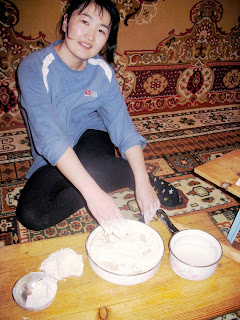
My friend Sarantuya let me help her make buuz a few nights before Tsagaan Sar. Presentation is critical, however, and my buuz prompted plenty of laughter. So, we decided to eat the buuz we made that night. They're a relatively easy thing to make: dough from flour and water, rolled into 3" circles and filled with cube-sized beef (cut from massive slabs of meat), onion and salt; pinch the edges together (that's the part I haven't yet mastered--it's harder than it looks); steam for 15 minutes. (I'm looking forward to a buuz party or two when we get back!) They are really juicy and delicious! If I do decide to go back to being a vegetarian after I return to America, I'll definitely have to wait until after I've made (and eaten) a few dozen buuz with people.


Our Tsagaan Sar began the morning after Bituun, when our friend Sarantuya, her husband Dohgie and her daughter Solongo picked us up and brought us to their brother's house. The first thing that happened was that Sarantuya's uncle, who was the oldest family member present, sat in the most comfortable chair, put on his hat and deel, and waited to be greeted. The second oldest family member put on his hat, and held a blue hadag (silk scarf) across his hands. He went to Sarantuya's uncle, and, holding his arms out and under Sarantuya's uncle's arms, kissed him on each cheek. The other family members, oldest to youngest, then did the same. This greeting, given only on Tsagaan Sar, is called the "zolgoh," and it symbolizes the younger person's respect for and willingness to help the older person. The younger person's arms out, palms up, under the older person's arms is a sign that says "I shall support you always." Is that perfectly awesome, or what? Maybe it's gestures and beliefs such as these that have kept this culture strong for such a very, very long time.


The Tsagaan Sar table is overflowing with food!
There are all of the same foods served as at Bituun, and at very traditional homes, the "otes" is also served. The otes is the sheep's back, with the head on top, sitting always at the head of the table. I hope the photo doesn't make people too squeamish, but it's reality. And although I thought I'd be completely freaked out to see it, it actually didn't really bother me at all. The death of livestock here is an absolute matter of survival for the people, and, therefore, it's everywhere. It also involves reverance for the animal, something which in our American plastic-packaged society doesn't exist for most people. There is a real connection here between people and their food, and a profound appreciation for this gift the animals provide.
The exclusively Tsagaan Sar "piece de resistance" is the "harvsai." It's a 3 to 21 (odd numbers only) stack of hard, oval-shaped bread, decorated with sugar cubes, candies, and/or pieces of aruul. Stacks are shorter and smaller in young families, or couples whose parents are alive. Older folks have taller and often wider stacks. The display remains on the table until the fourth day, when it is finally dismantled and eaten. By then, the bread is quite hard, but people just dunk it in their sootai tsai (milk tea) and it's just fine. We tried some before Tsagaan Sar and it was like a combination of a huge donut and fried dough. How can you possibly go wrong?!


Another tradition practiced at every holiday or
significant gathering, is the sharing of the "khamareen tamekh," or "nose tobacco," aka snuff. The older men and women in every family have their own special bottle for the snuff, and to share it with guests is an important welcome gesture. Everyone was very patient with us as they explained that we must put just a very tiny spot of it on our finger, or else we would sneeze uncontrollably. I still managed to sneeze a few times.

I mentioned that folks give gifts on Tsagaan Sar, as well. That means that whenever you go to someone's home, they give you a gift! Sort of a hostess gift, in reverse. Jimmy and I were given everything from leather key chains to a box of milk. The gifts were always given to us when it was clear our hosts were "wrapping up" our visit for us. It's interesting that the Mongolian word for happy is the same as good-bye. We joked that maybe the present means "We're glad you could come, now we're happy to say bye-bye!" It worked great -- Jimmy and I never really knew how long we should stay, so it was a great cue to skidoo. And on Tsagaan Sar, with families welcoming as many as 50 guests in a day, it's very important to, as we used to say in the restaurant business, "get 'em in, get 'em out." We never felt the least bit like people were rushing us, though. They were just letting us know, in an extremely kind way, that it was time for us to go.

While all of the visiting is going on, every few minutes, children knock on the door and wait to be given candy or an apple or a crisp 20 tugrik (about 20 cents) bill. It's like a 3-day Halloween, without the costumes. Some children knock and wait, some just walk right in. Even strangers will come and visit. While we were at Sarantuya's, 3 young men came in, sat down, waited to be served shots of vodka, hung out for about half and hour, and left. I asked Sarantuya afterwards who they were, and she said she had no idea, nor did her husband! Your door is open to absolutely everyone on this holiday, and, for many folks, every other day as well.

A real highlight for both of us came on the second night. Jimmy and I had both gotten into our long johns and settled in for some cold pasta salad, when our neighbors' grandaughter knocked on our door and invited us to come across the hall to eat and celebrate with them. We had seen her grandparents once or twice, but had never spoken to them. They are a well-known couple in town and very well respected, and they welcomed us as if they'd been waiting nearly 6 months to do so. Their granddaughter, Gantsetseg, is a junior in high school and speaks English quite well, so she translated most things for us. However, Shataar, her grandfather, made it very clear that Jimmy and I must learn Mongolian, and that he and his wife, Poorevsuren, are there to help us every day. In fact, he said at least half a dozen times that he wants us to visit every day, and that if there's ever anything at all that we need, we must come to them. We felt very honored by his offer, especially since our predecessors (also American volunteers who lived in our same apartment for 2 years) were never in their apartment. So now, suddenly, finally, we know our neighbors! There are a few people in the building whom we always greet, but these folks feel like friends, and that's a wonderful feeling! For us, it's too bad Tsagaan Sar comes only once a year, but for Mongolians, who often go into debt (never mind the stress) because of it, I'm sure once a year is more than enough. Next year, we'll have to do some hosting ourselves. By then, we may have 50 guests of our own visiting!